

1. THE BATTLE OF MARATHON
This plate shows Athenian hoplites as they would have appeared around the time of Marathon, sheltering from the Persian cavalry in an olive grove sacred to Athena. The bronze greaves worn by all figures were of the ‘anatomical’ type, contoured to the muscles and held in place by the flexibility of bronze.
(1) Athenian hoplite
This individual wearing full armour is based on a figure shown on the Oxford Brygos Cup.
(2) Lightly clad hoplite
At Marathon the Athenians ran against the Persian forces (Herodotus, Hist. 6.122; Aristophanes, Acharnians 699), but the evidence of the Oxford Brygos Cup suggests they did not leave their armour behind. Nevertheless, we have chosen an alternative approach. The sparse evidence for family shield emblems at Athens has been discussed elsewhere (Sekunda & McBride 1986: 10). In the early 5th century, most hoplites seem to have adopted shield devices appropriate to the god under whose protection they had placed themselves. In this case it is Dionysus, symbolized by a trefoil of ivy leaves, the ivy being sacred to that god.
(3) Athenian hoplite
This man has chosen to proclaim his wealth by choosing as his shield device the riding-box of a racing chariot, demonstrating that he is sufficiently wealthy to maintain a chariot team that has won a prize in an athletic competition. Shield devices could be chosen for a wide variety of reasons. He wears a helmet of the so-called ‘Chalcidian’ type, but in this case made up of iron plates used for the one-piece visor, plus nasal and neck-guard, while the skull is manufactured from iron scales.
This plate shows Athenian hoplites as they would have appeared around the time of Marathon, sheltering from the Persian cavalry in an olive grove sacred to Athena. The bronze greaves worn by all figures were of the ‘anatomical’ type, contoured to the muscles and held in place by the flexibility of bronze.
(1) Athenian hoplite
This individual wearing full armour is based on a figure shown on the Oxford Brygos Cup.
(2) Lightly clad hoplite
At Marathon the Athenians ran against the Persian forces (Herodotus, Hist. 6.122; Aristophanes, Acharnians 699), but the evidence of the Oxford Brygos Cup suggests they did not leave their armour behind. Nevertheless, we have chosen an alternative approach. The sparse evidence for family shield emblems at Athens has been discussed elsewhere (Sekunda & McBride 1986: 10). In the early 5th century, most hoplites seem to have adopted shield devices appropriate to the god under whose protection they had placed themselves. In this case it is Dionysus, symbolized by a trefoil of ivy leaves, the ivy being sacred to that god.
(3) Athenian hoplite
This man has chosen to proclaim his wealth by choosing as his shield device the riding-box of a racing chariot, demonstrating that he is sufficiently wealthy to maintain a chariot team that has won a prize in an athletic competition. Shield devices could be chosen for a wide variety of reasons. He wears a helmet of the so-called ‘Chalcidian’ type, but in this case made up of iron plates used for the one-piece visor, plus nasal and neck-guard, while the skull is manufactured from iron scales.
Giuseppe Rava. Este dibujo muestra a los hoplitas atenienses tal y como eran en la época de la batalla de Maratón, refugiándose de la caballería persa en el olivar de Atenea. Las grebas de bronce usadas por todos los hoplitas eran del tipo "anatómico", seguían el alivio de los músculos y se sostenían en la pierna debido a la flexibilidad del bronce.
(1) Athenian hoplite
This individual wearing full armour is based on a figure shown on the Oxford Brygos Cup.
(2) Lightly clad hoplite
At Marathon the Athenians ran against the Persian forces (Herodotus, Hist. 6.122; Aristophanes, Acharnians 699), but the evidence of the Oxford Brygos Cup suggests they did not leave their armour behind. Nevertheless, we have chosen an alternative approach. The sparse evidence for family shield emblems at Athens has been discussed elsewhere (Sekunda & McBride 1986: 10). In the early 5th century, most hoplites seem to have adopted shield devices appropriate to the god under whose protection they had placed themselves. In this case it is Dionysus, symbolized by a trefoil of ivy leaves, the ivy being sacred to that god.
(3) Athenian hoplite
This man has chosen to proclaim his wealth by choosing as his shield device the riding-box of a racing chariot, demonstrating that he is sufficiently wealthy to maintain a chariot team that has won a prize in an athletic competition. Shield devices could be chosen for a wide variety of reasons. He wears a helmet of the so-called ‘Chalcidian’ type, but in this case made up of iron plates used for the one-piece visor, plus nasal and neck-guard, while the skull is manufactured from iron scales.
This individual wearing full armour is based on a figure shown on the Oxford Brygos Cup.
(2) Lightly clad hoplite
At Marathon the Athenians ran against the Persian forces (Herodotus, Hist. 6.122; Aristophanes, Acharnians 699), but the evidence of the Oxford Brygos Cup suggests they did not leave their armour behind. Nevertheless, we have chosen an alternative approach. The sparse evidence for family shield emblems at Athens has been discussed elsewhere (Sekunda & McBride 1986: 10). In the early 5th century, most hoplites seem to have adopted shield devices appropriate to the god under whose protection they had placed themselves. In this case it is Dionysus, symbolized by a trefoil of ivy leaves, the ivy being sacred to that god.
(3) Athenian hoplite
This man has chosen to proclaim his wealth by choosing as his shield device the riding-box of a racing chariot, demonstrating that he is sufficiently wealthy to maintain a chariot team that has won a prize in an athletic competition. Shield devices could be chosen for a wide variety of reasons. He wears a helmet of the so-called ‘Chalcidian’ type, but in this case made up of iron plates used for the one-piece visor, plus nasal and neck-guard, while the skull is manufactured from iron scales.

2.TRAINING
(1) Athlete training for the hoplitodromos
Runners in the hoplitodromos were equipped with a shield, helmet and greaves, but no cuirass. The wearing of greaveswas discontinued after c.450. It is sometimes difficult to decide if a hoplitodromos or a military event is being shown on a given Athenian vase. The hoplitodromos, as it was an athletic event, was run naked, whereas, if the context is military, the hoplite generally wears an ephaptis ‘wraparound’ cloak about his loins. If spears are being carried, it is likely to be a military scene, it being too dangerous to carry them in the hoplitodromos. The hoplitodromos was run with a set of competition shields specially designed to be of equal, and perhaps reduced, weight. These were stored in temples or arsenals, where they can be described by the diminutive term aspidiskoi in the inventories that were periodically carried out and recorded in inscriptions. If used in games held to honour a particular god, all the set of shields would be decorated with symbols associated with the god: for example, a swastika sun-symbol, which was associated with Apollo; or perhaps the initials of the god, ‘ΑΘΗ’ for Athena for example. In the example illustrated here, the young athlete carries a shield decorated with the figure of an athlete running in the hoplitodromos. Ephēboi and older young men would participate in the hoplitodromos.
(2) Athenian ephēbos
This figure is based on an Attic lekythos dating to 470–460 and showing a young man wearing a black chlamys and petasos, carrying a pair of hunting spears. Hunting was a favourite pursuit of young men.
(3) Ephebic cavalryman (?)
I have suggested before (Sekunda & McBride 1986: 19), based on a white-ground lekythos dating to c.415 and showing a young horseman dressed in a black cloak, that it is conceivable that ephebic training was extended to young cavalrymen at that time. Subsequent research has shown that the depiction of young horsemen wearing black cloaks goes back farther than that. This figure is based on another white-ground lekythos in Boston dating to c.440: a couple of years after the suggested date for the cavalry reform attributed to Pericles. One of the skills demanded of the Athenian hippeis was javelin-throwing from horseback, which is attested in 5thcentury vases. In fact, Sir John Beazley, running out of fresh names, came up with the designation ‘Hippakontist Painter’ (Beazley 1963: 769–770) for a minor artisan active in the second quarter of the 5th century with a predilection for
painting such scenes on his produce. Training in this skill at this early date was poorly organized, if at all. Plato records (Meno 93d) that Themistocles personally instructed his son Cleophantus in horse-riding and in throwing a javelin from horseback, though this could date to Themistocles’ period of exile.
(1) Athlete training for the hoplitodromos
Runners in the hoplitodromos were equipped with a shield, helmet and greaves, but no cuirass. The wearing of greaveswas discontinued after c.450. It is sometimes difficult to decide if a hoplitodromos or a military event is being shown on a given Athenian vase. The hoplitodromos, as it was an athletic event, was run naked, whereas, if the context is military, the hoplite generally wears an ephaptis ‘wraparound’ cloak about his loins. If spears are being carried, it is likely to be a military scene, it being too dangerous to carry them in the hoplitodromos. The hoplitodromos was run with a set of competition shields specially designed to be of equal, and perhaps reduced, weight. These were stored in temples or arsenals, where they can be described by the diminutive term aspidiskoi in the inventories that were periodically carried out and recorded in inscriptions. If used in games held to honour a particular god, all the set of shields would be decorated with symbols associated with the god: for example, a swastika sun-symbol, which was associated with Apollo; or perhaps the initials of the god, ‘ΑΘΗ’ for Athena for example. In the example illustrated here, the young athlete carries a shield decorated with the figure of an athlete running in the hoplitodromos. Ephēboi and older young men would participate in the hoplitodromos.
(2) Athenian ephēbos
This figure is based on an Attic lekythos dating to 470–460 and showing a young man wearing a black chlamys and petasos, carrying a pair of hunting spears. Hunting was a favourite pursuit of young men.
(3) Ephebic cavalryman (?)
I have suggested before (Sekunda & McBride 1986: 19), based on a white-ground lekythos dating to c.415 and showing a young horseman dressed in a black cloak, that it is conceivable that ephebic training was extended to young cavalrymen a

The plate recreates the images of three horsemen from the West frieze of the Parthenon. The frieze was sculpted between c.443 and c.437 and probably depicts the procession of the Greater Panathenaic festival from the Leokoreion by the Dipylon Gate up to the Parthenon. The ‘Greater’ Panathenaic festival, during which weapons would not be carried, was celebrated every four years, the ‘Lesser’ Panathenaia annually. Horsemen take up nearly half the length of the frieze. Despite repeated attempts to detect ‘uniformity’ in the dress worn by the horsemen, Stevenson (2003) is probably correct in stating that at this time, dress depended entirely on the personal choice of the cavalryman.
(1) Athenian cuirassed cavalryman
This depiction is based on figure W7. On the sculpture, the folds in the ‘overfall’ of the tunic tied at the waist can be seen beneath the cuirass. He wears a ‘muscle-cuirass’ without shoulder-guards, so as not to impede javelinthrowing.
(2) Cavalryman wearing Thracian dress
This depiction is based on figure W8. All figures of horsemen shown on the Parthenon frieze are beardless youths except for two, W8 and W15, who along with S2–S7 wear Thracian dress. Thracians wore fox-skins on their heads, multi-coloured, patterned cloaks and boots of doeskin reaching up to the knee (Herodotus, Hist. 7.75). This figure wears a normal Greek tunic, but a Thracian hat, cloak and boots. It is uncertain whether the neck-flap to the hat was made of fox-skin or of multi-coloured Thracian textile, and it could have ended in a right angle, or had the shape of a ‘beaver’s tail’. Robertson and Frantz (1975: ad pl. VIII 15) suggest that these bearded figures, on account of their senior age are hipparchoi, which seems reasonable, but the fact that they both wear Thracian dress may be coincidental. In the Archaic period, influential Athenian families had estates or castles in the coastal regions of Thrace: perhaps these Thracian contacts were maintained.
(3) Cavalryman in Thessalian dress
Based on W17 from Slab IX, this rider wears a Thessalian hat and cloak. Many prominent Athenian aristocratic families maintained close relationships with their Thessalian counterparts and imitated their dress. The Thessalian type of cloak, usually with a different-coloured border at either side, was wrapped around the left shoulder and pinned with a fibula above the right shoulder. It hung round the body in a very distinctive way, hanging in a V-shape at the front and back and open on the right-hand side.
Giuseppe Rava🇮🇹. Caballería ateniense del siglo V: un jinete ateniense con una coraza musculosa, jinetes con ropas tracias y tesalias, respectivamente.
El dibujo recrea las imágenes de tres jinetes del Friso Oeste del Partenón. El friso fue creado entre 443 y 437 y probablemente representa la procesión de los participantes de los Grandes Juegos Panatenaicos desde el Leocoreion a través de la Puerta del Dipylon hasta el Partenón. Los Grandes Juegos Panatenaicos, durante los cuales estaba prohibido portar armas, se celebraban cada cuatro años, y la Panatenia Menor, anualmente. Los jinetes ocupan casi la mitad del friso. A pesar de los repetidos intentos de identificar una cierta "uniformidad" en la vestimenta de los jinetes, probablemente sea necesario admitir que en ese momento la forma de vestir dependía completamente de la elección personal del soldado de caballería.

4. ATHENIAN HOPLITES DURING THE 5TH CENTURY
All these figures carry hoplite spears about 2.4m in length, each with a small leaf-shaped iron spearhead and cylindrical bronze spear-butt. By this time, greaves have been abandoned in the search for mobility. All the hoplites are shown barefoot, as they are in all forms of Greek art. The normal Athenian hoplite was a farmer who worked barefoot in the fields, took his physical exercise barefoot, even naked, and saw no need to don footwear when called upon to perform military service. Boots were worn for specific purposes, such as for hunting, in which the hunter was likely to have to run through prickly undergrowth. Footwear would not be worn by infantry unless it was extremely cold. When texts mention soldiers barefoot, they generally do so in a context in which all the troops have been overtaken by winter while dressed in their summer clothing. Xenophon tells us (Hell. 2.1.1) that after the disastrous naval battle of Arginusae in 406, the Athenian troops that were left on Chios under the command of Eteonicus, as long as the summer lasted, existed upon the produce of the season and by working for hire up and down the island. When winter came on, however, and they were without food, poorly clothed and unshod, they got together and agreed to make an attack upon Chios. The same thing happened to the Athenian forces when they were surprised by the unusually severe winter of 430/29 in Chalcidice. Plato tells us that ‘in those parts the winters are awful’, and while the other Athenians ‘wrapped ourselves up with prodigious care, and after putting on our shoes we muffled up our feet with felt and little fleece’, Socrates ‘walked out in that weather, clad in just such a cloak [himation] as he was always wont to wear, and he made his way more easily over the ice unshod than the rest of us did in our shoes’ (Symp. 220a–c). Socrates never wore shoes (Xenophon, Mem. 1.6.2). In the decades around the end of the 5th century and the beginning of the 4th century, nakedness became very frequent in depictions of Athenian warriors, whether in sculpture or in the fast-disappearing painted vases. This might not be so fantastic as it seems at first. Warriors exercised naked, and warfare was an activity from which women were largely excluded. A recent work (Murray 2022) explores the universality of nudity in Greek art and culture. We have no evidence of any uniformity in dress in the Athenian army at this period. Some Athenians were killed at the battle of Delium in 424. The Thespian contingent stood their ground while the other Boeotians had fled. The Athenians enveloped them, and ‘getting into confusion owing to their surrounding the enemy killed one another’ (Thucydides, Hist. 4.96.3).
(1) Hoplite, c.440
From the middle of the 5th century onwards, the cuirass and greaves were worn less and less, as full-scale pitched battles became more infrequent. The Corinthian helmet dominated the scene for most of the 5th century, but then lost its popularity.
(2) Hoplite, c.410
This figure is based on the central figure depicted on the tombstone of Sosias and Kephisdōros. During the Peloponnesian War, the Athenian forces adopted the pilos helmet, which practically displaced the Corinthian and all other forms of helmet. This was because the pilos helmet offered advantages in terms of visibility and light weight that made it suitable for campaigns rather than pitched battles. Another factor could be military ‘fashion’ – the Lacedaemonian army, which was the first to adopt the pilos helmet, was the pre-eminent military force in the Greek world at the time.
(3) Taxiarchos
This figure represents an attempt to reconstruct the appearance of a taxiarchos based on passages in Aristophanes.
All these figures carry hoplite spears about 2.4m in length, each with a small leaf-shaped iron spearhead and cylindrical bronze spear-butt. By this time, greaves have been abandoned in the search for mobility. All the hoplites are shown barefoot, as they are in all forms of Greek art. The normal Athenian hoplite was a farmer who worked barefoot in the fields, took his physical exercise barefoot, even naked, and saw no need to don footwear when called upon to perform military service. Boots were worn for specific purposes, such as for hunting, in which the hunter was likely to have to run through prickly undergrowth. Footwear would not be worn by infantry unless it was extremely cold. When texts mention soldiers barefoot, they generally do so in a context in which all the troops have been overtaken by winter while dressed in their summer clothing. Xenophon tells us (Hell. 2.1.1) that after the disastrous naval battle of Arginusae in 406, the Athenian troops that were left on Chios under the command of Eteonicus, as long as the summer lasted, existed upon the produce of the season and by working for hire up and down the island. When winter came on, however, and they were without food, poorly clothed and unshod, they got together and agreed to make an attack upon Chios. The same thing happened to the Athenian forces when they were surprised by the unusually severe winter of 430/29 in Chalcidice. Plato tells us that ‘in those parts the winters are awful’, and while the other Athenians ‘wrapped ourselves up with prodigious care, and after putting on our shoes we muffled up our feet with felt and little fleece’, Socrates ‘walked out in that weather, clad in just such a cloak [himation] as he was always wont to wear, and he made his way more easily over the ice unshod than the rest of us did in our shoes’ (Symp. 220a–c). Socrates never wore shoes (Xenophon, Mem. 1.6.2). In the decades around the end of the 5th century and the beginning of the 4th century, nakedness became very frequent in depictions of Athenian warriors, whether in sculpture or in the fast-disappearing painted vases. This might not be so fantastic as it seems at first. Warriors exercised naked, and warfare was an activity from which women were largely excluded. A recent work (Murray 2022) explores the universality of nudity in Greek art and culture. We have no evidence of any uniformity in dress in the Athenian army at this period. Some Athenians were killed at the battle of Delium in 424. The Thespian contingent stood their ground while the other Boeotians had fled. The Athenians enveloped them, and ‘getting into confusion owing to their surrounding the enemy killed one another’ (Thucydides, Hist. 4.96.3).
(1) Hoplite, c.440
From the middle of the 5th century onwards, the cuirass and greaves were worn less and less, as full-scale pitched battles became more infrequent. The Corinthian helmet dominated the scene for most of the 5th century, but then lost its popularity.
(2) Hoplite, c.410
This figure is based on the central figure depicted on the tombstone of Sosias and Kephisdōros. During the Peloponnesian War, the Athenian forces adopted the pilos helmet, which practically displaced the Corinthian and all other forms of helmet. This was because the pilos helmet offered advantages in terms of visibility and light weight that made it suitable for campaigns rather than pitched battles. Another factor could be military ‘fashion’ – the Lacedaemonian army, which was the first to adopt the pilos helmet, was the pre-eminent military force in the Greek world at the time.
(3) Taxiarchos
This figure represents an attempt to reconstruct the appearance of a taxiarchos based on passages in Aristophanes.
Giuseppe Rava🇮🇹. Hoplitas atenienses en el siglo V: hoplita (440 a.C.), hoplita (410 a.C.) y taxiarca.
Los hoplitas están armados con lanzas de unos 2,4 m de largo, cada una con una pequeña punta de hierro en forma de hoja y un pomo cilíndrico de bronce. Para entonces, las chicharronas habían sido abandonadas en favor de la movilidad. Todos los hoplitas están representados descalzos, como en todas las obras de arte de la antigua Grecia. El hoplita ateniense promedio era un granjero que trabajaba descalzo en los campos, hacía ejercicio descalzo, incluso desnudo, y no veía la necesidad de usar zapatos cuando era llamado al servicio militar. Los zapatos se usaban para fines especiales, como la caza, cuando lo más probable es que el cazador tuviera que vadear la maleza espinosa. La infantería no usaba zapatos a menos que hiciera mucho frío.

5. NAVAL PERSONNEL
The same citizens were called upon to fight in the fleet as in the land army.
(1) Naval archer
Representations of Greek archers, as opposed to Scythians, Persians and other foreigners, are quite rare in Athenian art. The majority portray figures from Greek mythology such as Odysseus or Philoctetes. These representations depict archery equipment in a remarkably uniform way. As this type of equipment was familiar to the artists, we can assume that it was used by Athenian archers. As the Athenians had no skills in bow-making, archery equipment had to be imported from the Black Sea area. It was not astronomically expensive. A bow and quiver worth 15 drachmas were offered as first prize and a bow worth 7 drachmas as second prize in a competition at Coresia on the island of Ceos in the early 3rd century (IG xii.5 647, 27–28). Nevertheless, as the archers must have been recruited from the poorer Athenians, we presume that they would have been supplied with their equipment. The Scythian gorytos was a combined quiver and bowcase. In the Athenian examples, although of the same basic shape, the arrows only are kept inside the arrow-case. This was manufactured in two wooden halves covered with leather, to judge from the outside, which appears to be dappled ox-hide. We can see a frame running along the side and bottom of the case, holding the two halves together. The arrow-case was open at one end, where it was covered by a flap of material or leather. The bow, when not in use, was held by two straps on the outside of the arrow-case. The shape of the two arms of the Scythian bow were asymmetrical, as it was designed to be shot from horseback. The arrow-case was worn at the waist, in the Scythian way.
(2) Naval peltast
The crews of the triremes would increasingly be disembarked to fight as peltasts in the 4th century. This man carries a fighting spear as depicted on the kōthon from Stuttgart (see here), rather than javelins; Roman velites carried seven javelins.
(3) Naval hoplite
According to the ‘Decree of Themistocles’, moved when the Athenians decided to abandon Attica to the Persians, the number of fighting men aboard a trireme was 14, including four archers and ten young epibatai (Fornara 1977: no. 55). Literally, epibatēs means ‘passenger’, but the term is usually translated as ‘marine’. Plutarch says (Themistocles 14.1) that at Salamis there were 18 fighting men per ship: four archers and 14 hoplites. In 426, during operations in Aetolia, the Athenians disembarked 300 epibatai from 30 ships (Thucydides, Hist. 3.95.2) together with archers (3.98.1). About 120 of the hoplites ‘all of the same age, finished here, the best men in truth the city of Athens lost in this war’ (3.98.4). The first fleet that was sent to Sicily consisted of 60 ‘swift’ triremes with 700 thetes aboard as epibatai.
Around the middle of the 5th century, hoplite shield devices become confined to a narrow range of symbols, a star or a laurel wreath being the favourites. This shield is decorated with a star contained within a laurel wreath surrounded by a wave pattern, based on a jug in the Louvre (G 571) decorated by the ‘Shuvalov Painter’, active c.440–410. We have no idea what colours would be used. Shields could be decorated quite elaborately. According to Plutarch (Nicias 28.5), the shield of Nicias, who was very wealthy, was decorated in gold and purple interwoven with great skill. The days of hereditary shield devices were over. Plutarch tells us (Alcib. 16.1–2) that Alcibiades had made for himself a gilded shield bearing no ancestral device, but an Eros armed with a thunderbolt.
The same citizens were called upon to fight in the fleet as in the land army.
(1) Naval archer
Representations of Greek archers, as opposed to Scythians, Persians and other foreigners, are quite rare in Athenian art. The majority portray figures from Greek mythology such as Odysseus or Philoctetes. These representations depict archery equipment in a remarkably uniform way. As this type of equipment was familiar to the artists, we can assume that it was used by Athenian archers. As the Athenians had no skills in bow-making, archery equipment had to be imported from the Black Sea area. It was not astronomically expensive. A bow and quiver worth 15 drachmas were offered as first prize and a bow worth 7 drachmas as second prize in a competition at Coresia on the island of Ceos in the early 3rd century (IG xii.5 647, 27–28). Nevertheless, as the archers must have been recruited from the poorer Athenians, we presume that they would have been supplied with their equipment. The Scythian gorytos was a combined quiver and bowcase. In the Athenian examples, although of the same basic shape, the arrows only are kept inside the arrow-case. This was manufactured in two wooden halves covered with leather, to judge from the outside, which appears to be dappled ox-hide. We can see a frame running along the side and bottom of the case, holding the two halves together. The arrow-case was open at one end, where it was covered by a flap of material or leather. The bow, when not in use, was held by two straps on the outside of the arrow-case. The shape of the two arms of the Scythian bow were asymmetrical, as it was designed to be shot from horseback. The arrow-case was worn at the waist, in the Scythian way.
(2) Naval peltast
The crews of the triremes would increasingly be disembarked to fight as peltasts in the 4th century. This man carries a fighting spear as depicted on the kōthon from Stuttgart (see here), rather than javelins; Roman velites carried seven javelins.
(3) Naval hoplite
According to the ‘Decree of Themistocles’, moved when the Athenians decided to abandon Attica to the Persians, the number of fighting men aboard a trireme was 14, including four archers and ten young epibatai (Fornara 1977: no. 55). Literally, epibatēs means ‘passenger’, but the term is usually translated as ‘marine’. Plutarch says (Themistocles 14.1) that at Salamis there were 18 fighting men per ship: four archers and 14 hoplites. In 426, during operations in Aetolia, the Athenians disembarked 300 epibatai from 30 ships (Thucydides, Hist. 3.95.2) together with archers (3.98.1). About 120 of the hoplites ‘all of the same age, finished here, the best men in truth the city of Athens lost in this war’ (3.98.4). The first fleet that was sent to Sicily consisted of 60 ‘swift’ triremes with 700 thetes aboard as epibatai.
Around the middle of the 5th century, hoplite shield devices become confined to a narrow range of symbols, a star or a laurel wreath being the favourites. This shield is decorated with a star contained within a laurel wreath surrounded by a wave pattern, based on a jug in the Louvre (G 571) decorated by the ‘Shuvalov Painter’, active c.440–410. We have no idea what colours would be used. Shields could be decorated quite elaborately. According to Plutarch (Nicias 28.5), the shield of Nicias, who was very wealthy, was decorated in gold and purple interwoven with great skill. The days of hereditary shield devices were over. Plutarch tells us (Alcib. 16.1–2) that Alcibiades had made for himself a gilded shield bearing no ancestral device, but an Eros armed with a thunderbolt.
Giuseppe Rava🇮🇹. Guerreros atenienses en la marina: arquero, peltasta y hoplita. Los mismos ciudadanos fueron reclutados en la marina como en el ejército de tierra.
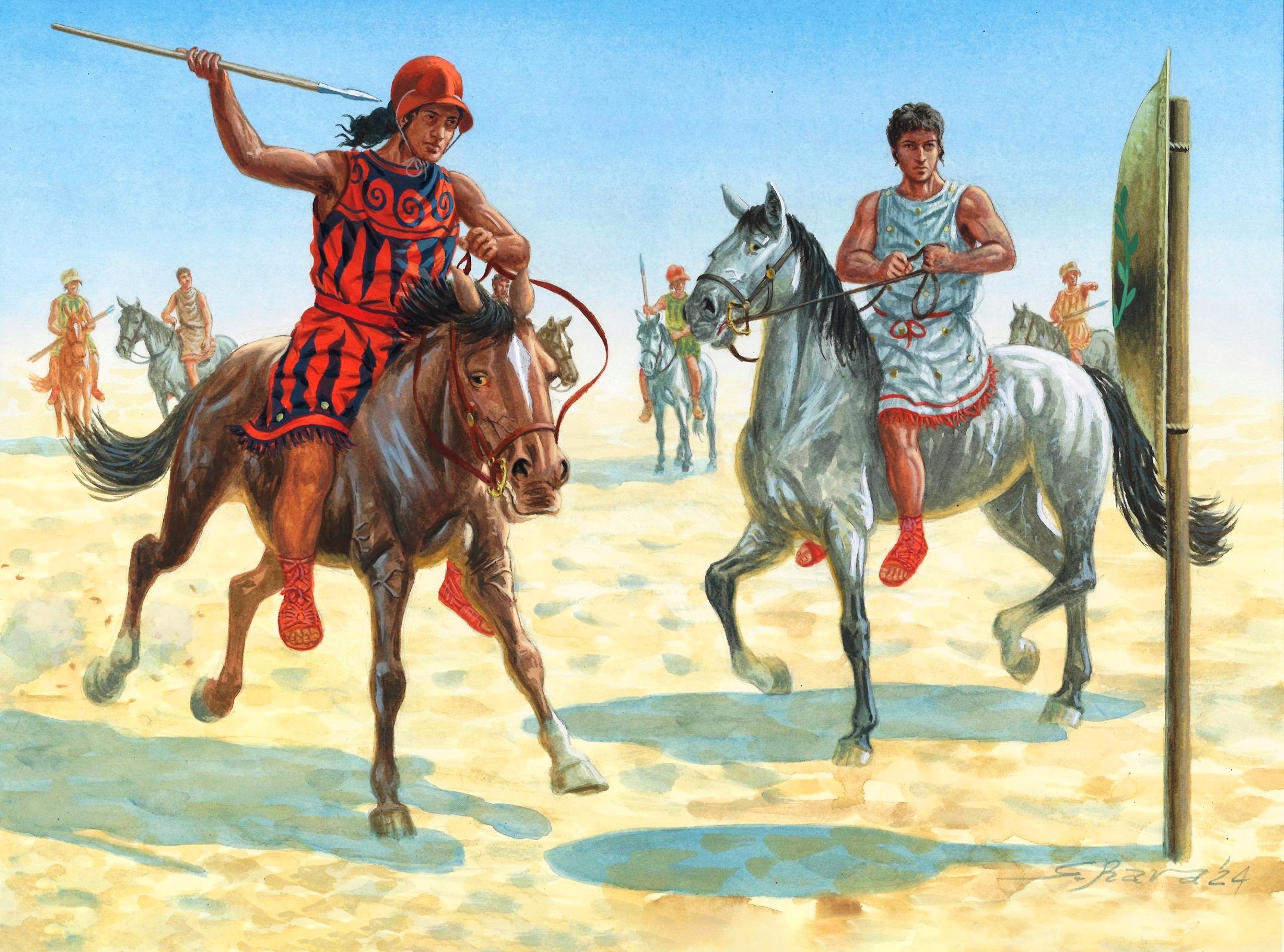
6. JAVELIN-THROWING FROM HORSEBACK COMPETITION
Xenophon emphasized (Hipparchikos 1.6, 12; Mem. 3.3.7) that one of the duties of the hipparchos was to train as many men as possible to throw the javelin from horseback. The competition called ‘javelin-throwing from horseback’ (af’hippou akuntizonti) is mentioned by Xenophon (Hipp. 1.26) and in an inscription dating to the early 4th century (IG ii² 2311, 68–70). The competition is also recorded on seven Attic vases, the oldest dating to 415–405 (Sparkes 1977: 11), some of them recording victory in the Panathenaic Games. The young cavalrymen were very particular about their appearance and took pride in it. Long hair was very fashionable, as it was at Lacedaemon, with whose political system the young men sympathized. They had extremely rich parents, capable of supporting the upkeep of a horse, which had no use in agriculture before the horse-collar reached Europe in Byzantine times; and they could afford the most expensive fashions.
Xenophon emphasized (Hipparchikos 1.6, 12; Mem. 3.3.7) that one of the duties of the hipparchos was to train as many men as possible to throw the javelin from horseback. The competition called ‘javelin-throwing from horseback’ (af’hippou akuntizonti) is mentioned by Xenophon (Hipp. 1.26) and in an inscription dating to the early 4th century (IG ii² 2311, 68–70). The competition is also recorded on seven Attic vases, the oldest dating to 415–405 (Sparkes 1977: 11), some of them recording victory in the Panathenaic Games. The young cavalrymen were very particular about their appearance and took pride in it. Long hair was very fashionable, as it was at Lacedaemon, with whose political system the young men sympathized. They had extremely rich parents, capable of supporting the upkeep of a horse, which had no use in agriculture before the horse-collar reached Europe in Byzantine times; and they could afford the most expensive fashions.
Giuseppe Rava🇮🇹. Competiciones de lanzamiento de jabalina desde un caballo.
Jenofonte enfatizó que uno de los deberes de Hiparco era enseñar a tantas personas como fuera posible a lanzar una jabalina desde un caballo. Una competición llamada "lanzar una jabalina desde un caballo" (af'hippou akuntizonti) es mencionada por Jenofonte (Hipp. 1.26) y en una inscripción que data de principios del siglo IV (IG ii2 2311, 68-70). La competencia también está registrada en siete jarrones áticos, el más antiguo de los cuales data de 415-405 (Sparks 1977: 11), algunos de los cuales representan victorias en los Juegos Panatenaicos. Los jóvenes jinetes eran muy exigentes con su apariencia y estaban orgullosos de ello. El pelo largo estaba muy de moda, como en Lacedemonia, cuyo sistema político simpatizaban los jóvenes. Tenían padres extremadamente ricos que podían mantener un caballo que no se usaba en la agricultura; Y podían permitirse la ropa más cara.

7. THE BATTLE OF TAMYNAE
In this plate both cavalrymen are shown riding bareback (cavalrymen are shown riding bareback in the Parthenon frieze). Proper saddles only came into use in the Roman period, but prior to that the saddlecloth (ephippios) had gradually come into use, at first in the Achaemenid Empire, and then among the Greeks and the other peoples that were living near it. When the confiscated property of the hermokopidai, the people accused of mutilating the herms (sculptures) of Athens before the Sicilian expedition set sail from the city in 415, was auctioned off, among the items sold were two saddlecloths belonging to Alcibiades. Meritt (1984: 95) has pointed out that there are no representations of saddlecloths either in vase-paintings or in sculpture of the Greek mainland before the end of the 5th century. He believes that Alcibiades, fond of luxury and extravagance, was living ahead of his time in acquiring these saddlecloths as well as other imports from Miletus, for example, which are recorded among his possessions. Meritt also points out that Xenophon in his On Horsemanship (7.5), published c.369–65, when dealing with the question of how one should seat oneself on a horse, says that whether riding bareback, or seated on an ephippios, one should not ride as if sitting on a chair, but should grip the horse with one’s thighs, and adopt an upright stance which will allow the rider to throw his javelin and deliver a blow from horseback with more force. Antiphanes was an Athenian comic poet whose first play was staged c.383. In a fragment of his play Hippeis preserved in Athenaeus (Deip. 11.503a), the hippeis were forced to use their ephipipoi as coverings for the dinnercouch: presumably in the field. He also mentions that they were compelled to use their beautiful piloi as kadoi. Kados was a Greek word normally used for ‘bucket’, in this context for containing wine. We can add this to the reference in Aristophanes to a phlyarchos eating alphita from his pilos: in both cases the piloi could not have been made out of felt, but must have been made of bronze.
(1) Hamippos
The details of the dress and equipment worn by this figure are indistinct, but a dagger in the right hand, and a baldrick (cross belt) running from the right shoulder, can be made out. This would presumably have carried the scabbard of the dagger. He is probably wearing a conical felt cap, a pilos, rather than a bronze helmet of the same shape.
(2) Prodromos
Cephisodorus probably served in the Athenian prodromoi, as he is unarmoured apart from his Boeotian helmet in plain bronze. He wears a cloak, tunic and riding boots. A sword belt is slung over his right shoulder.
(3) Cavalryman
This figure is based on a number of sources, the most important of which is an Athenian marble funerary lekythos (EMA 2586). The central figure shows a warrior equipped with a spear, which was originally painted on the sculpture; a Boeotian helmet; a muscle-cuirass with shoulder-flaps and two rows of groin-flaps; and a tunic and cloak. From the second quarter of the 4th century, cavalry were increasingly used to fight cavalry, rather than unformed infantry, and this made necessary a change in the type of spear used. By the second quarter of the century the traditional cavalry spear had been replaced by another model, called a xyston, or ‘whittled’ spear. It was used by the Macedonian cavalry at the battle of the Granicus in 334. Plutarch mentions (Life of Alexander 16.11) that at the battle of Granicus, Kleitos ‘the Black’ saved the life of Alexander by killing the Persian Rhoisakes with his xyston. In his account of the battle, Arrian tells us (Anabasis of Alexander 1.15.5–8) that the Macedonian cavalrymen were getting the better of the battle because they were fighting with cornel-wood xysta against the paltai of the Persians. At this point in the battle, Alexander’s spear was broken. He called on Aretas, one of the royal grooms, to hand over his spear, but Aretas had broken his lance and was fighting on with the broken half. Shortly after, Alexander killed Spithridates by pushing his xyston through the Persian’s cuirass. Then, Arrian tells us (1.16.1), the Persians started to lose as they and their horses were being struck in the face with xystoi. From these passages we can see that the spear used by the Macedonian Companion Cavalry was the xyston, it was made from cornel-wood, and it was possible to fight with the rear end of it when it was broken in battle.
In this plate both cavalrymen are shown riding bareback (cavalrymen are shown riding bareback in the Parthenon frieze). Proper saddles only came into use in the Roman period, but prior to that the saddlecloth (ephippios) had gradually come into use, at first in the Achaemenid Empire, and then among the Greeks and the other peoples that were living near it. When the confiscated property of the hermokopidai, the people accused of mutilating the herms (sculptures) of Athens before the Sicilian expedition set sail from the city in 415, was auctioned off, among the items sold were two saddlecloths belonging to Alcibiades. Meritt (1984: 95) has pointed out that there are no representations of saddlecloths either in vase-paintings or in sculpture of the Greek mainland before the end of the 5th century. He believes that Alcibiades, fond of luxury and extravagance, was living ahead of his time in acquiring these saddlecloths as well as other imports from Miletus, for example, which are recorded among his possessions. Meritt also points out that Xenophon in his On Horsemanship (7.5), published c.369–65, when dealing with the question of how one should seat oneself on a horse, says that whether riding bareback, or seated on an ephippios, one should not ride as if sitting on a chair, but should grip the horse with one’s thighs, and adopt an upright stance which will allow the rider to throw his javelin and deliver a blow from horseback with more force. Antiphanes was an Athenian comic poet whose first play was staged c.383. In a fragment of his play Hippeis preserved in Athenaeus (Deip. 11.503a), the hippeis were forced to use their ephipipoi as coverings for the dinnercouch: presumably in the field. He also mentions that they were compelled to use their beautiful piloi as kadoi. Kados was a Greek word normally used for ‘bucket’, in this context for containing wine. We can add this to the reference in Aristophanes to a phlyarchos eating alphita from his pilos: in both cases the piloi could not have been made out of felt, but must have been made of bronze.
(1) Hamippos
The details of the dress and equipment worn by this figure are indistinct, but a dagger in the right hand, and a baldrick (cross belt) running from the right shoulder, can be made out. This would presumably have carried the scabbard of the dagger. He is probably wearing a conical felt cap, a pilos, rather than a bronze helmet of the same shape.
(2) Prodromos
Cephisodorus probably served in the Athenian prodromoi, as he is unarmoured apart from his Boeotian helmet in plain bronze. He wears a cloak, tunic and riding boots. A sword belt is slung over his right shoulder.
(3) Cavalryman
This figure is based on a number of sources, the most important of which is an Athenian marble funerary lekythos (EMA 2586). The central figure shows a warrior equipped with a spear, which was originally painted on the sculpture; a Boeotian helmet; a muscle-cuirass with shoulder-flaps and two rows of groin-flaps; and a tunic and cloak. From the second quarter of the 4th century, cavalry were increasingly used to fight cavalry, rather than unformed infantry, and this made necessary a change in the type of spear used. By the second quarter of the century the traditional cavalry spear had been replaced by another model, called a xyston, or ‘whittled’ spear. It was used by the Macedonian cavalry at the battle of the Granicus in 334. Plutarch mentions (Life of Alexander 16.11) that at the battle of Granicus, Kleitos ‘the Black’ saved the life of Alexander by killing the Persian Rhoisakes with his xyston. In his account of the battle, Arrian tells us (Anabasis of Alexander 1.15.5–8) that the Macedonian cavalrymen were getting the better of the battle because they were fighting with cornel-wood xysta against the paltai of the Persians. At this point in the battle, Alexander’s spear was broken. He called on Aretas, one of the royal grooms, to hand over his spear, but Aretas had broken his lance and was fighting on with the broken half. Shortly after, Alexander killed Spithridates by pushing his xyston through the Persian’s cuirass. Then, Arrian tells us (1.16.1), the Persians started to lose as they and their horses were being struck in the face with xystoi. From these passages we can see that the spear used by the Macedonian Companion Cavalry was the xyston, it was made from cornel-wood, and it was possible to fight with the rear end of it when it was broken in battle.


This plate tries to reconstruct the appearance of Athenian soldiers in the 330s and 320s.
(1) Hoplite
This figure is based on the grave-monument of Aristonautes. It seems that in the earlier representations of muscle-cuirasses on Athenian funerary sculpture they are not fitted with groin-flaps, but in the later ones they are. Xenophon recommends (On Horsemanship 12.4) that groinflaps should be of such a material and size that they will keep out missiles. When closed, the cheek-flaps of the Phrygian helmet gave almost complete protection to the facial area.
(2) Catapult instructor
The gastraphetēs continued to be used alongside more powerful and sophisticated models developed during the course of the later 4th century. It was only after the gastraphetēs was returned to a horizontal position that a bolt (not shown) could be placed on the slider.
(3) Impressed man
This figure seeks to reconstruct the appearance of a poor man unable to equip himself with arms and armour, who is issued by the Athenian state with a shield and spear. The shield bears the letter ‘A’, standing for ‘The Athenians’. We only have evidence for shields decorated with the letter Alpha from the Hellenistic period. Nevertheless, with the accumulating number of hoplite shields under state ownership stored in the chalkothēkē on the Acropolis, and later in the skeuothēkē in the agora, the idea must have arisen to mark them in some way. We have already seen that shields of a standard, reduced weight produced for the hoplitodromos would have been stored alongside these shields in the armouries, some at least decorated with the letters ‘AΘΗ’ or ‘A’. The idea of marking these shields with the letter ‘A’ must surely have come from these sporting shields among which they were stored. American excavations in the Athenian Agora discovered a dump of lead tokens in a well some 70m away from the site of the Athenian skeuothēkē in the agora (Kroll 1977). These lead tokens show on one side an item of armour, such as a helmet or a cuirass, and on the reverse the letters A, B, Γ and Δ, which Kroll interpreted as standing for its size (no example of a reverse stamped with the letter ‘B’ has survived). Other, related material has been gathered by Schäfer (2019). A number of these tokens show hoplite shields with the letter ‘A’ as a blazon. Though these tokens seem to be early Hellenistic in date rather than late Classical, the same shield blazon could well have been in use earlier on. The only literary evidence we have concerning Athenian shield decoration during this period is Plutarch’s statement (Dem. 20.2) that at the battle of Chaeronea, Demosthenes had ‘Good Luck!’ written on his shield in gold. We are not told whether the words were written on the inside of the shield, or on the rim, or alongside a blazon.